Is This Autograph Real?

Autograph authentication · field guide

Is This
Autograph
Real?

Before you buy, sell, or authenticate a signed item, learn the 12 checks that can expose many fake, printed, copied, traced, secretarial, and mechanically reproduced autographs.

Free to read, and written to be used with the item in front of you. This site is educational — no page here issues an opinion of authenticity.

Exhibit — genuine1.4 s
Strokes
3
Pen lifts
2
Retouches
0

A signature is a motor habit, not a picture. Once you know what a habit looks like on paper, a copy of one is loud.

The whole method

Autograph authentication is not based on one characteristic. Experienced authenticators examine the signature, writing instrument, surface, provenance, signing habits, known exemplars, and other evidence together.

Before anything else

Start here: 5 fast questions

These five resolve a great many items in a few minutes, with nothing but good light and a magnifier. Each one links through to the check in the guide that treats it properly.

  1. 01question

    Is the signature actually written in ink?

    Printed, reproduced, facsimile, autopen, and mechanically applied signatures can all look handwritten in a photograph. Ink laid down by a moving hand sits in the surface, varies in width, and catches the light unevenly. A printed signature is part of the image itself — flat, even, and made of the same dots as everything else on the page. Look at it in raking light and under magnification before you believe your eyes.

    Check 04 — speed and flow →
  2. 02question

    Does the signature match the period?

    The pen, marker, paper, photographic stock, and the item itself all have to be plausible for the day the autograph was supposedly signed. Ballpoints reached American shops in October 1945; the Sharpie fine point launched in 1964; glossy resin-coated photographic paper is largely a 1970s-and-later product. A 1930s studio portrait signed in felt tip is settled before you look at a single stroke.

    Check 09 — ink and paper age →
  3. 03question

    Is there believable provenance?

    Where an autograph came from matters, and a vague story is not the same thing as documented provenance. A signing date, a witness, a ticket stub, a dated letter, an estate inventory, or a proof photograph of the signing are all things somebody else can check. “From a private collection” and “my uncle worked in the industry” are not — they cannot be confirmed or refuted by anyone.

    Check 11 — provenance →
  4. 04question

    Does it look too perfect?

    Genuine signatures vary. The same person signing twice in one minute produces two different objects — different spacing, different pressure, a different tail on the last letter. Signatures that are identical to one another, or unusually neat and mechanical, deserve additional examination rather than confidence. Sameness is the signature of a machine or a template, not a hand.

    Check 07 — slant and proportion →
  5. 05question

    Does the certificate actually verify?

    A Certificate of Authenticity does not make an autograph genuine — it records somebody’s opinion, and anyone with a printer can produce one. Wherever possible, verify the certificate number through the issuing company, using contact details you found yourself rather than the ones printed on the certificate.

    Check 12 — certificates →
  6. Then work the full list, in order.

    Twelve checks, from the physics of the writing through to the paperwork. Any single clear failure is grounds to stop.

    See all 12 autograph checks

Important

A Certificate of Authenticity is not proof by itself

A certificate is only as credible as the person or company issuing it. Forged and meaningless certificates exist. Check the authentication company, look for a verifiable certification number, research the authenticator’s experience, and evaluate the autograph itself.

What you are actually looking at

Common types of fake or non-hand-signed autographs

Not all of these were made to deceive. Several were produced openly and only become a problem when sold as hand-signed — which is why the seller’s description matters as much as the item.

01

Preprinted signatures

The signature was printed onto the item at the factory, along with the picture. Publicity photographs, album inserts, and fan-club mailers were produced this way by the thousand, and the signature usually sits under the surface gloss rather than on top of it.

02

Autopen signatures

A machine holds a real pen and traces a fixed template, so the result is real ink on real paper. Because the template never changes, autopen signatures are dimensionally identical to each other, carry no pressure variation, and stop dead at both ends.

03

Stamped signatures

A rubber or self-inking stamp of the signature, pressed onto the item. Stamps leave a flat, even deposit of ink, sometimes with a faint square outline or a blotted, spread edge where the rubber pushed ink outwards.

04

Secretarial signatures

A real person — an assistant, studio employee, or family member — signed on the celebrity’s behalf, often with their permission. These pass every physics-based check because a hand really wrote them, and they are caught only by comparison against known genuine examples.

05

Traced signatures

A genuine signature was copied stroke by stroke, usually over a lightbox or through the paper. Tracing is slow, so the line has an even width, no pressure story, blunt starts and stops, and often a fine regular wobble along the long curves.

06

Forged signatures

Somebody practised the signature and wrote it freehand. Good forgers get the silhouette right and the construction wrong — the wrong loop closes first, a stroke crosses on the wrong side, or the pen was lifted and put back to repair a shape.

07

Printed or digitally reproduced signatures

A scan of a genuine autograph, printed onto a new item with a modern printer. Under a loupe the line breaks into a regular dot pattern or shows a soft inkjet halo, and the “ink” never indents the surface at all.

Real vs fake

Look at the item, then call it

Two plates to try here. Guess real or guess fake, and the card shows the verdict, what an examiner read to reach it, and the percentage of people who called it correctly — then open the full set.

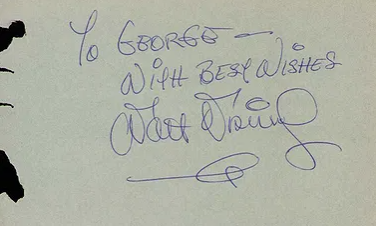
Plate 01Walt Disney

Is this Walt Disney autograph authentic or fake?

An album page inscribed in blue ink, "To George — With Best Wishes", signed Walt Disney with a flourish beneath the name.

Call it

One call per plate. The verdict, the reading, and how many people got it right follow your answer.

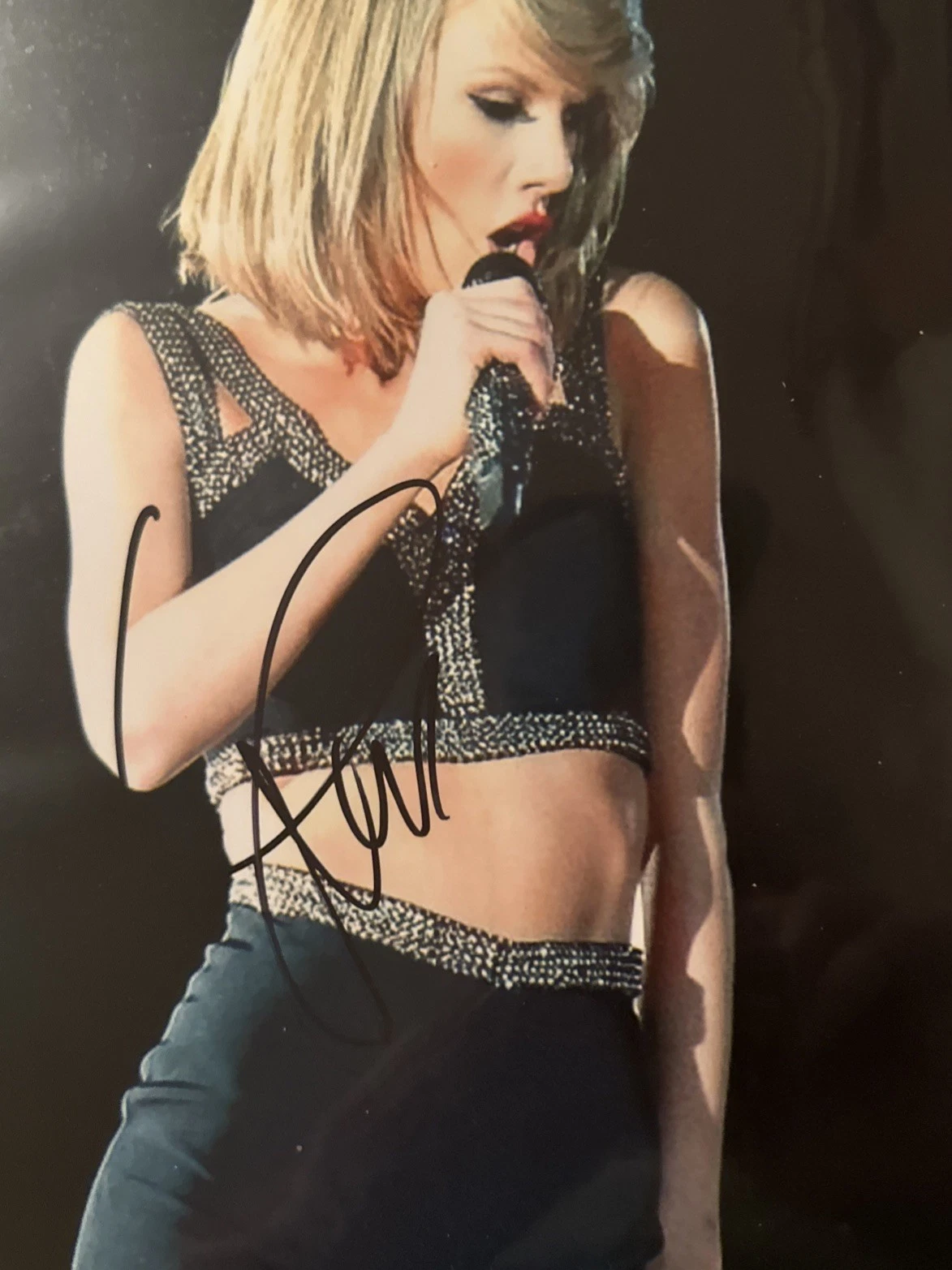
Plate 06Taylor Swift — signed photo

Is this signed Taylor Swift concert photo real?

A colour concert photograph of Taylor Swift singing into a handheld microphone, signed in broad black marker straight across the centre of the image.

Call it

One call per plate. The verdict, the reading, and how many people got it right follow your answer.

12 plates filed, 7 more signers queued

The full set runs through Disney, Taylor Swift, and the names coming next — Michael Jackson, Cristiano Ronaldo, Freddie Mercury, The Beatles, and more.

View more plates

Before you pay

Red flags when buying an autograph online

None of these proves a fake on its own. Two or three together are a reason to walk away, and every one of them is something you can check before money moves.

Check 11 — provenance
  • Seller refuses to provide close-up photographs

    Every tell worth seeing lives in a close-up. A seller who will not send one is protecting the sale, not the item.

  • Seller will not show the back of the item

    The reverse carries stamps, labels, dealer marks, and the evidence of a modern reprint. It is the cheapest photograph to take and the most revealing.

  • Certificate number cannot be verified

    An unverifiable certificate is the same as no certificate. Check the serial with the issuer, using contact details you found independently.

  • Large quantities of supposedly rare signatures

    Scarce signatures do not arrive in bulk. A seller with a dozen of something that rarely surfaces has a source worth explaining.

  • Every signature looks unusually clean or identical

    Real signing varies. Uniformity across a batch points to a template, a stamp, a machine, or one very busy hand.

  • Provenance consists only of an unverifiable story

    A history that exists solely in the listing text cannot be confirmed, and it disappears the moment you try to resell the item.

  • Price is dramatically below normal market value

    Ask what the seller knows that the market does not. A genuine signed item priced far under comparable sales is usually priced correctly for what it is.

  • Seller pressures the buyer to act immediately

    Urgency exists to prevent examination. Nothing genuine loses value because you took a day to check it.

  • Seller avoids questions about where the autograph came from

    Honest sellers answer provenance questions plainly, and say so when they do not know. Deflection is information.

After the twelve

Passing all twelve does not make it authentic

A clean run through the twelve tests is not a verdict. What it does is tell you whether the item is worth sending to a professional — and what to put in front of them when you get there. A secretarial signature, an autopen, and the work of a skilled forger can all pass every test on this page, because in each case a real hand or a real machine put real ink on the surface at speed.

So treat the result as a triage decision rather than a conclusion. Keep three lists — what passed, what failed, and what you could not judge — and hand all three to someone with an exemplar library. A clear failure early on saves you the fee; a clean pass is the point at which paying for an opinion starts to make sense.

Selling

Interested in selling your newly found items?

An attic find, an inherited album, a box from an estate sale — if you would rather move an item on than keep it, Piece of the Past has a page for sellers setting out what it buys and what it takes on consignment. Settle the authentication question first. What you can document about a signature is what sets its price, and an unexamined autograph sells for what an unexamined autograph is worth.

Common questions

Questions people ask before they pay

How can I tell if an autograph is real?
Judge how it was written before you judge how it looks. Genuine signing is fast muscle memory, so the line tapers, the pressure rises and falls, and the pen lands and leaves in motion. Then check that the pen and paper could have existed on the claimed date, compare against dated examples of the same person, and look at the item’s history and paperwork. No single check proves an autograph genuine, and neither does passing all twelve — a clean pass means the item is worth taking to a professional.
Can a fake autograph have a COA?
Yes, and it very often does. A certificate is a printed opinion with no licensing requirement behind it, so a forger can produce one for pennies — and certificates from respected houses are themselves counterfeited and attached to fakes. A certificate only adds anything when it names the person who formed the opinion, illustrates your actual item, and carries a serial number you can verify with the issuer directly.
What is an autopen?
An autopen is a machine that holds an ordinary pen and traces a fixed template of a signature, so the result is real ink on real paper. Presidents, astronauts, senators, and studios have used them since the mid-twentieth century for correspondence. Because the template never changes, autopen signatures are dimensionally identical to one another and carry no pressure variation — they are identified by matching the pattern, not by judging the ink.
Can you authenticate an autograph from a photo?
Good photographs rule many items out — anachronistic ink, halftone printing, blunt terminals, tremor, and autopen matches are often visible in a sharp, well-lit close-up. Confirming that something is genuine is much harder from images alone, because pressure, indentation, and how the ink sits in the surface are best read with the item in hand. Most examiners give a preliminary view from photographs and say plainly when they need the original.
Where can I get an autograph authenticated?
Through an experienced authenticator who specialises in the relevant field, or a third-party service if you need an opinion the resale market already recognises. What matters is that a named individual forms the opinion, that they have handled many examples of that specific signature, that the opinion is illustrated with your actual item and carries a verifiable serial, and that the markets you might sell into accept it.
Still not sure?

Some autographs cannot be judged from a checklist alone

Some autographs cannot be judged responsibly from a checklist alone. Valuable, historic, unusual, or questionable signatures should be examined by someone with substantial hands-on experience.

Ask Samuel Kevin Martin

Samuel Kevin Martin

Samuel Kevin Martin has worked professionally with autographs for more than four decades and has served as a court-certified autograph expert. He is the founder of Piece of the Past, Inc. and has written extensively about autograph authentication, collecting, forgery, and memorabilia.

As published by Piece of the Past

Twicecourt-certified
Accepted as an expert in entertainment memorabilia in court proceedings — accountability that goes beyond a printed certificate.
40+years examining
Four decades of signatures, forgeries, autopens, and secretarial hands passing across one desk.
12books written
Published titles on authentication and collecting, alongside an ongoing role in the trade.
100sof articles
Written on forgery, certificates, and how the memorabilia market actually works.

Credentials as published by Piece of the Past. Samuel Kevin Martin is authentication lead, piece of the past; confirm current services and terms with the company directly.

What a professional examination involves →

Contact

Ask an autograph expert

Send a short description of the item and clear photographs — the signature square-on and close, the whole object, and the reverse. Say what you know about where it came from, and which checks you could not judge. That last part is useful information, not a weakness.

autographexpert01@gmail.com

Educational information on this site is intended to help collectors identify warning signs and make better-informed decisions. Determining authenticity can require examination by an experienced professional.